
Monday July 8
What a glorious motor in the sunshine. We left Rhu after breakfast, porridge, not a breathe of wind except that generated by Temptress’ forward motion. Our destination was Millport, Cumbrae. It’s a place we’d never been too.
As we negotiated the channels, vessels and buoyage off Gourock the Waverley appeared behind us. At roughly double our speed this beautiful old lady eventually overhauled us, her passengers taking photos of Temptress as we did the same of her.

A lot of industrial buildings rose ahead on the mainland side. Looks like a nuclear power station I said then after checking the chart which said Hunterston – correction two defunct nuclear power stations. My encyclopaedic knowledge of British Power Stations goes back to a nine month work placement with the CEGB laboratories, Leatherhead as an applied chemistry undergraduate. I love them especially Battersea with its Delft tiles, sadly now gone in an act of corporate vandalism and the huge underground cavern that is Dinorwig in North Wales which I had an amazing tour of.
Nuclear power appears green in that no hydrocarbons are burnt to generate the steam which in turn powers the turbines that create the electricity. However these two, having powered Scotland and beyond for some 46 years in the case of Hunterston A, are and will be for the foreseeable future, a radioactive problem that another generation will have to solve. Even the reactor building has to be left for over three quarters of a century in quiescence before it can be demolished. The spent fuel, presumably stored at Sellafield, will be a problem long after that. Its neighbour Hunterston B has more recently been shutdown. The whole site is effectively out of use for a century or more to come. I’m not anti-green or anti-nuclear just sad that my parent’s generation didn’t think things through. Have it now and pass the consequences on is not in the long term, feasible, cost effective or environmentally friendly.
Most of my work placement though was spent on another issue of the moment, acid rain. Analysing water samples to prove or disprove the now defunct theory that acid rain was dissolving aluminium from Norwegian granite which in turn was causing Alzheimer’s in Nordic countries where folk drink water extracted from their local lakes.
Acid rain is very real. However most of my results from the hundreds of Nordic lake water samples I tested every week for the presence of free aluminium were zero! And aluminium compounds continue to be used during the water treatment process.
My memories of Leatherhead were corridors of dustbins filled with bottles of lake water, some lovely scientists who played as hard as they worked, my lab colleagues tried and failed to introduce me to archery. They did however arrange a regular lift from my digs to the labs as well as ensuring I visited many of the other labs on site which hosted far more exciting projects like greenhouses containing huge soil cores complete with trees and shrubs that they were watering with ‘acid rain’. The water samples thus produced added to our collection of dustbins. Then there was a high voltage bay – more a large shed with an overhead gantry crane and walkways high up. Here they tested pylon insulators to destruction, the bangs resonating across the site at times. And our nearest neighbours who created havoc in our laboratory one lunch time when their model of a pressurised cooling system blew up and shook the cabinets containing the majority of our scientific glassware off the adjoining wall!
More fun was to be had with water samples that purported to come from UK power stations for problem solving analysis especially when it turned out the station manager’s fishpond was the source! Contaminated turbine oils were the other task handed over to the resident student of the General Services Lab. I rapidly found out why, after hours spent watching the apparatus turn up the voltage until eventually a current was registered when the water content conducted. Slow and extremely boring requiring hours of patience and concentration that even then I wasn’t renowned for.
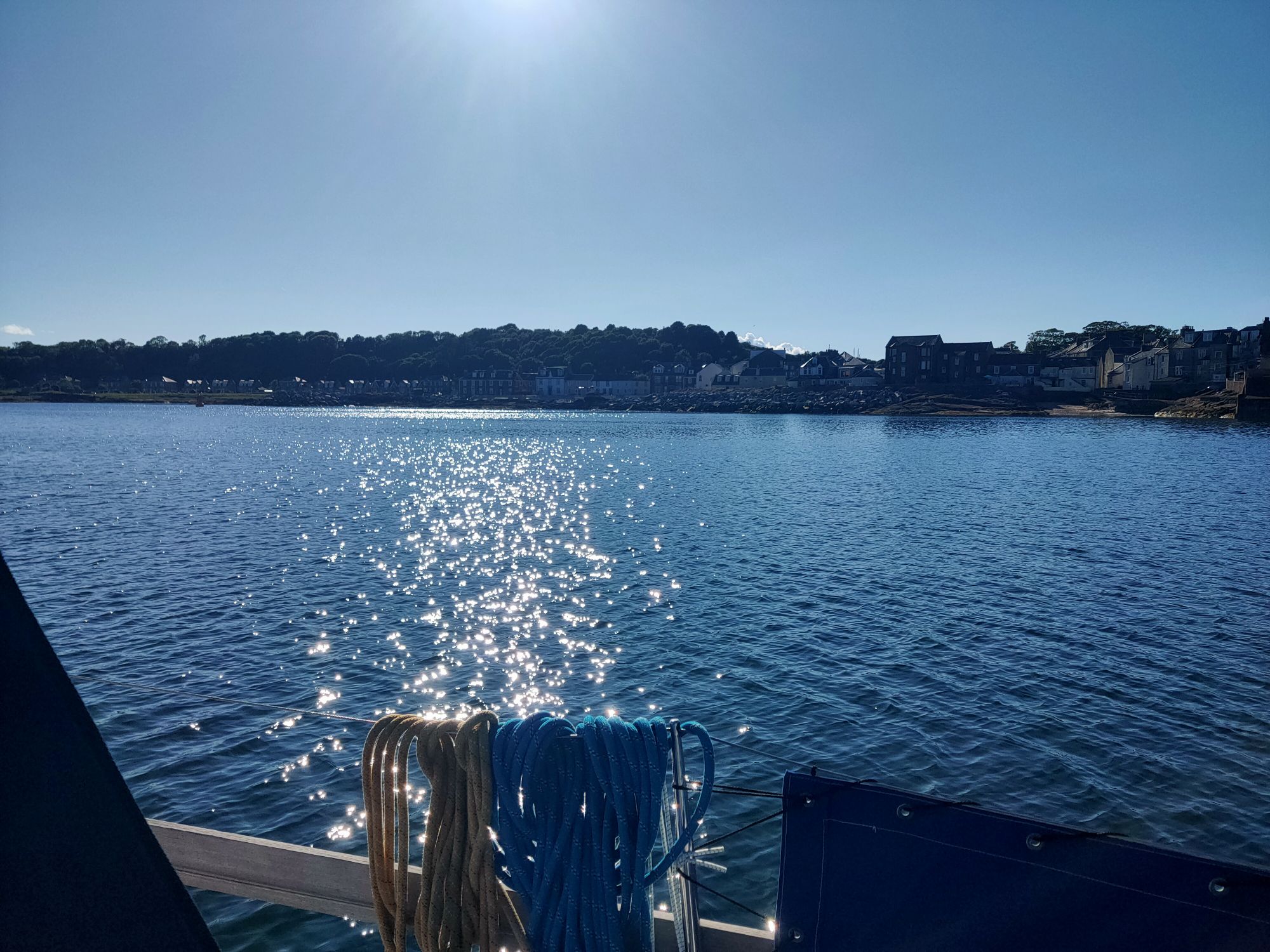
Back to our passage. The next surprise in store for Temptress’ crew was Millport. Now I’ve become involved as Sailing Sec at Donaghadee in a long term campaign, specifically the need for more all year round protection for the harbour. The club trustees have welcomed my interest and seem to think my wider sailing experience can contribute. Flattered but to be honest I’m not certain I can add to their years of local sailing knowledge. Anyway a few weeks ago there was some discussion about a flood protection scheme along the shore of a place called Millport as being somewhat pertinent to a breakwater off Donaghadee’s harbour. I hadn’t connected this with our intended destination so was rather bemused as Temptress rounded the south east corner of Greater Cumbrae Island to see a rock wall joining almost all the islands in the bay. No longer can a navigator pick up the 333 Deg transit on the pier and guide a boat safely in, if you do that in the dark you’ll have a big misadventure.
We checked and every source we had, even fairly recent chart updates, don’t show the new breakwater. The resultant new channel is well marked so we slipped through and selected a spot to anchor. Millport has free visitor moorings however Temptress is near their upper limit of 15 tonnes all up so we preferred the safety of our own chain as it was a bit breezy.
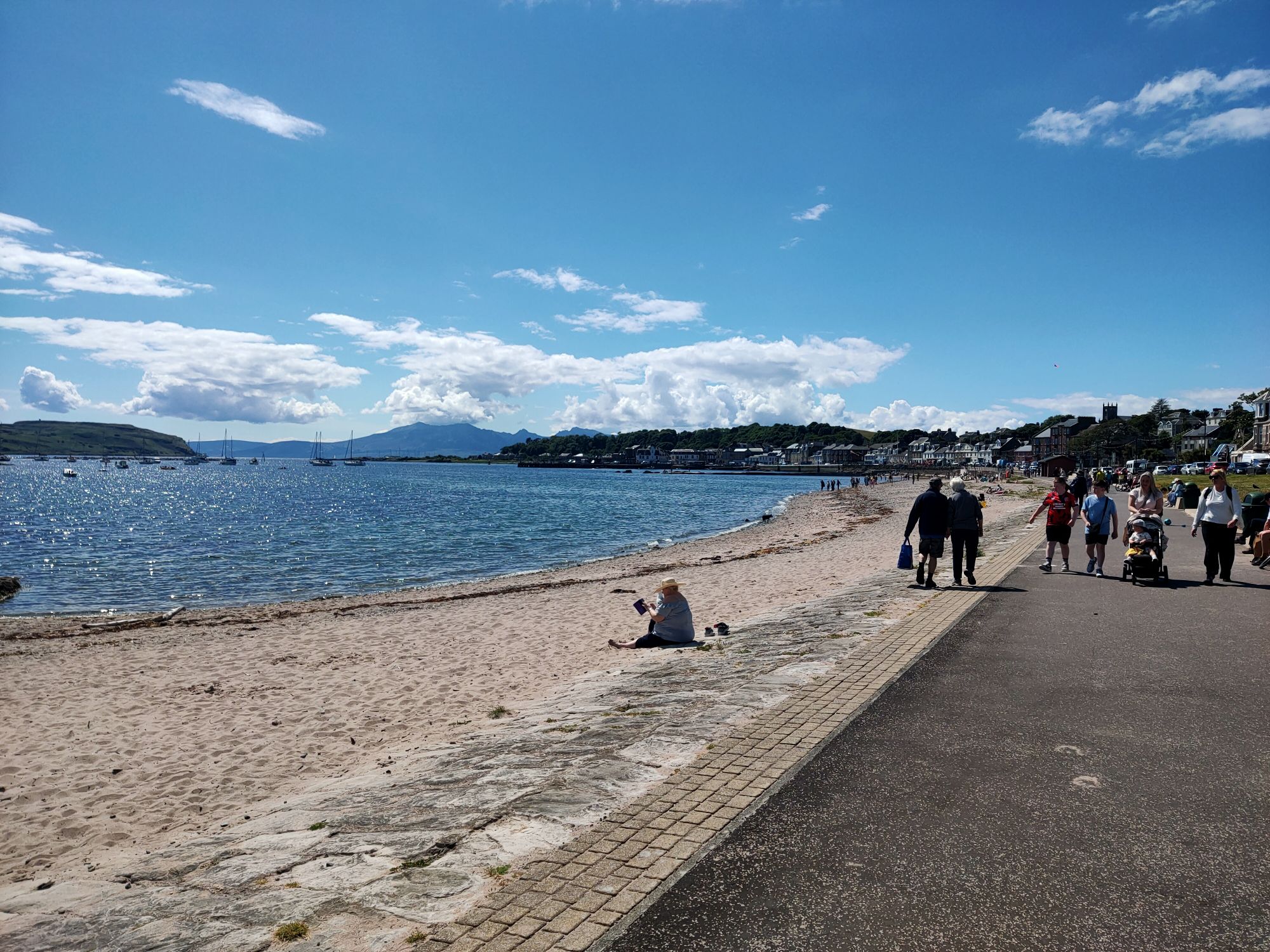
The dinghy was quickly launched and ashore in the sunshine we joined the crowds from Glasgow’s satellite towns who’d headed here for a day at the beach. Ice-creams were bought to be enjoyed as we walked the promenade eastwards along the shore. Sadly the yarn shop down near the pier is closed on Mondays so I couldn’t indulge.
The sea defence works are still in progress at the extreme ends of the town’s shore road. Huge blocks of honey coloured pre-formed concrete are being lifted into place. Some as we could see from the works completed have benches built in. It’s a massive undertaking but will greatly enhance the seafront when done.
We reached the Garrison, a former early Victorian home of the Bute family which now houses the museum, a cafe and a community space as well as various local arts and craft businesses off the courtyard at the rear. There were bouncy castles in the gardens, very popular in the sunshine. We counted the pubs and bars, at least five along the seafront, but waited til we returned to Temptress to indulge ourselves.


Returning to the pier where we had obeyed the sign not to tie up to the handrail on the steps we discovered a small tug-like harbour boat (it had mooring buoys aboard) was tied alongside the ladder we’d used to get ashore. Our poor Merrow looked squashed between the workboat bow and the large rib that had been there earlier. Closer inspection showed our dinghy firmly re-moored to the harbour boat’s samson post. Kevin climbed down the ladder into the rib, transferred to Merrow, started the engine, then hauled himself to the harbour boat. He stuffed his arm through the circular hole that served as a fair lead at the bow and felt around with guidance from his mate on the shore. Eventually he managed to undo the several figures of eight from the arms of the samson post. I and our bag of shopping were retrieved from the steps.
Despite the glorious day we were concerned, yet again the forecast was appalling. More strong winds, this time northerly, tomorrow. We discussed then planned a passage to Tarbert, though a friend, Moise, suggested nearby Largs or Troon and our actual preference would have been to tough it out at anchor. We’d decide in the morning.
Of note we have somehow managed to cover some three hundred and twenty five nautical miles since leaving Bangor!
 Wanderings